

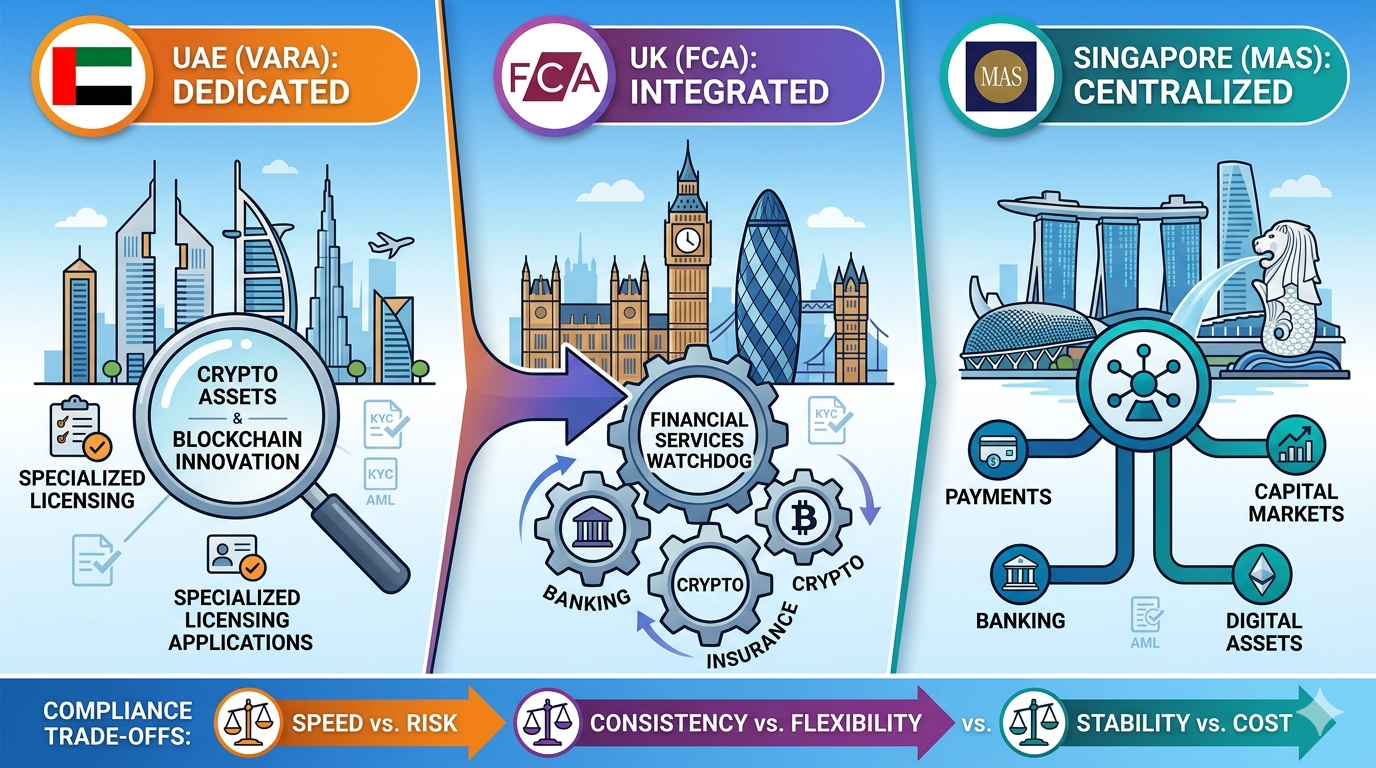
UAE vs UK vs Singapore — Three Approaches to the Same Crypto Challenge
The global regulatory landscape for digital assets is anything but uniform. While there is near-universal agreement among policymakers that cryptocurrencies and virtual assets require meaningful oversight, the how of that oversight remains deeply contested. The United Arab Emirates created a purpose-built crypto regulator — the Virtual Assets Regulatory Authority (VARA). The United Kingdom assigned crypto supervision to its established Financial Conduct Authority (FCA). Singapore integrated digital asset regulation into the mandate of the Monetary Authority of Singapore (MAS), which simultaneously serves as the nation’s central bank and financial supervisor. Three sophisticated jurisdictions, three fundamentally different architectural decisions, and one common challenge: how do you effectively regulate a rapidly evolving industry without stifling the innovation that makes it valuable? For compliance professionals operating across borders — or advising firms on market entry — understanding the structural logic, practical trade-offs, and downstream compliance implications of each model is not optional. It is essential.
◆
🇦🇪 The UAE Model: Purpose-Built Regulation Through VARA
Dubai’s approach is arguably the most ambitious structural experiment in global crypto regulation. In March 2022, the emirate enacted the Virtual Assets Regulation Law and established VARA as a dedicated, independent authority with an exclusive mandate over virtual asset activities within Dubai. This was not a side office within an existing ministry — it was a ground-up institution designed specifically for the crypto economy.
VARA operates an activity-based licensing framework, categorizing crypto businesses by what they actually do — exchange services, advisory, management, lending, transfer, and custody — and applying tailored rules to each activity. This granularity gives firms a degree of regulatory clarity that is often absent in jurisdictions where crypto is shoehorned into legacy financial services categories. VARA can also move quickly: because its sole focus is virtual assets, it does not need to compete internally for institutional bandwidth with banking, insurance, or securities teams.
VARA’s activity-based licensing model means that a single entity performing multiple crypto functions — for example, operating an exchange and providing custody — must obtain separate authorizations for each activity. This mirrors how traditional financial regulation separates dealing from safekeeping, but applies the principle natively to digital assets.
However, the model carries real risks. Building regulatory capacity from scratch means VARA must recruit, train, and retain specialized talent in a competitive global market. There is also the persistent concern of regulatory capture — when a regulator’s sole constituency is the industry it supervises, maintaining arm’s-length independence requires deliberate institutional discipline. Additionally, the UAE’s regulatory landscape is fragmented: VARA oversees Dubai, the Securities and Commodities Authority (SCA) has federal jurisdiction, and the Abu Dhabi Global Market (ADGM) operates its own framework. Compliance teams must navigate this multi-layered structure carefully.
The coexistence of VARA (Dubai), SCA (Federal), and ADGM/FSRA (Abu Dhabi) creates jurisdictional complexity within the UAE itself. Firms operating across emirates may face overlapping or divergent compliance obligations — a risk that must be mapped explicitly during market entry planning.
◆
🇬🇧 The UK Model: Integrated Oversight Through the FCA
The United Kingdom took the opposite architectural decision. Rather than creating a new institution, it assigned crypto oversight to the Financial Conduct Authority — a mature, well-resourced regulator with decades of supervisory experience across banking, insurance, capital markets, and consumer credit. The FCA currently oversees crypto assets primarily through an anti-money laundering registration regime under the Money Laundering Regulations (MLRs), with broader regulatory powers expected under the evolving Financial Services and Markets Act 2023 framework.
The advantages of this model are significant. The FCA brings deep enforcement experience, established supervisory methodologies, and a culture of consumer protection. There is no need to build institutional infrastructure from scratch — the legal powers, investigatory capabilities, and international cooperation networks already exist. Regulatory philosophy is also consistent: firms engaging in crypto activities face the same foundational expectations around governance, financial crime prevention, and consumer outcomes that apply across all FCA-regulated sectors.
“We will not compromise our standards to win business. Being tough on financial crime is not a barrier to innovation — it is the foundation for sustainable innovation.”— Nikhil Rathi, CEO, Financial Conduct Authority (2023)
But the integrated model has notable drawbacks. The FCA supervises over 50,000 firms across the financial services spectrum. Crypto, while growing rapidly, competes for attention with systemic priorities like prudential supervision, market integrity, and pension fund oversight. Some crypto firms have publicly expressed frustration with the pace and clarity of the registration process — the FCA’s rejection and withdrawal rate for crypto registrations has exceeded 80%, suggesting either extraordinarily high standards, insufficient applicant preparedness, or both. There is also a legitimate concern that applying legacy financial regulation frameworks to natively digital business models can produce interpretive ambiguity, leaving firms uncertain about what “good” looks like in practice.
Firms applying for FCA crypto registration should invest heavily in pre-application engagement and gap analysis. Demonstrating robust governance, a well-documented risk assessment, and a credible MLRO appointment dramatically improves registration outcomes. Treat the process as equivalent to a full financial services authorization — not a lightweight registration.
◆
🇸🇬 The Singapore Model: Centralized Authority Through MAS
Singapore’s model represents a third way — neither fully bespoke nor simply grafted onto an existing conduct regulator. The Monetary Authority of Singapore is unique among global regulators in that it simultaneously functions as the nation’s central bank, integrated financial supervisor, and innovation policy driver. When Singapore decided to regulate crypto, it did so by bringing digital payment tokens under the Payment Services Act (PSA) 2019, which was subsequently amended in 2022 to expand scope and tighten consumer protection requirements.
The MAS model offers holistic oversight. Because MAS supervises banks, insurers, capital markets, and payment services under one roof, it can assess how crypto intersects with traditional finance systemically. This is particularly valuable in areas like stablecoin regulation, DeFi-TradFi integration, and the institutional adoption of tokenized assets — all of which create cross-sectoral risks that siloed regulators may miss. Singapore’s licensing framework is clear, its enforcement credible, and its international reputation provides a powerful compliance “seal of approval” for firms seeking global institutional partnerships.
2019 — Payment Services Act Enacted
MAS established a licensing framework for digital payment token (DPT) services, creating one of the world’s first comprehensive crypto regulatory regimes anchored in payment law.
2022 — PSA Amendments & Consumer Protections
Following the Terra/LUNA collapse and FTX failure, MAS expanded licensing scope, introduced stricter custody requirements, and restricted retail marketing of crypto — signaling a more cautious posture.
2023–2024 — Stablecoin Regulatory Framework
MAS introduced a dedicated regulatory framework for single-currency stablecoins, positioning Singapore as one of the first jurisdictions to provide legal clarity for fiat-backed digital currencies.
The challenge for Singapore is balancing its reputation as an innovation hub with increasingly stringent risk controls. MAS has been notably selective — granting fewer than 20 major DPT licenses despite receiving hundreds of applications. For compliance teams, operating under MAS means meeting expectations that rival traditional banking standards in terms of AML controls, technology risk management, and board governance.
Comparing the Three Models: What Matters for Compliance
For compliance professionals evaluating these jurisdictions — whether for licensing strategy, cross-border risk assessments, or advisory purposes — the structural differences produce materially different compliance experiences. The following comparison distills the most operationally relevant dimensions:
A Practical Framework for Multi-Jurisdiction Compliance
For compliance teams operating across two or more of these jurisdictions — an increasingly common scenario — a structured approach to regulatory mapping is critical. The following framework provides a starting point for managing cross-jurisdictional complexity:
Identify the specific regulator, enabling legislation, and licensing category applicable to each jurisdiction. Do not assume equivalence — VARA’s activity licenses, the FCA’s MLR registration, and MAS’s PSA license each carry different scopes and obligations.
Create a detailed matrix comparing AML/CFT requirements, customer due diligence thresholds, transaction monitoring expectations, and reporting obligations across all three jurisdictions. Highlight gaps and conflicts.
Where feasible, design your compliance program to meet the most stringent requirement across jurisdictions. This reduces the complexity of maintaining separate compliance tracks and provides a defensible position with all three regulators.
All three regimes are evolving rapidly. Establish a regulatory intelligence function — or partner with an external provider — that tracks consultations, guidance updates, and enforcement actions across VARA, FCA, and MAS on at least a monthly basis.
Frequently Asked Questions
◆
There is no universally “correct” model for crypto regulation. The UAE’s VARA prioritizes specialization and speed, the UK’s FCA leverages institutional depth and enforcement credibility, and Singapore’s MAS offers systemic coherence and international prestige. Each model reflects deliberate trade-offs between agility and maturity, specialization and integration, innovation promotion and risk control. For compliance professionals, the regulatory architecture of a jurisdiction is not a background detail — it directly shapes licensing timelines, supervisory expectations, enforcement risk, and the cost structure of your compliance program. As digital asset regulation continues to evolve at pace across all three jurisdictions, the professionals who invest in understanding why these models differ — not just how — will be best positioned to advise their organizations strategically. Now is the time to audit your cross-jurisdictional compliance framework, identify gaps between these three regimes, and build the internal expertise to navigate a regulatory landscape that is converging in intent but diverging in execution.