

CAMS Exam 2026: The Complete Guide to Passing (Most Guides Get the Basics Wrong)
Every year, thousands of compliance professionals register for the Certified Anti-Money Laundering Specialist (CAMS) exam convinced that highlighting the study guide from cover to cover is enough. Most of them are surprised—sometimes painfully—when they sit down to 120 scenario-based questions that demand application, not recitation. This guide is different. We’ll walk you through eligibility, registration cost-saving tactics, the 2026 exam blueprint, study strategy, exam-day technique, and the single biggest misconception that separates people who merely pass from people who actually use the credential on day one of the job.
◆
1. Eligibility Requirements — The Step Most Candidates Skip
Before you even think about buying a study package, confirm you qualify. You need two things: an active ACAMS membership and a minimum of 40 eligibility credits. Credits come from a combination of:
- Academic qualifications — a relevant bachelor’s or master’s degree.
- Professional experience — years working in AML/CFT, compliance, law enforcement, or financial crime investigation.
- ACAMS training programs — Virtual Classroom or Live Prep courses count toward credits.
You do not need a university degree to sit the CAMS exam. ACAMS explicitly accepts credits from professional experience and their own training courses. If you’ve spent 3+ years in a compliance-adjacent role, you’re likely already eligible.
2. Registration — How to Save Real Money Before You Buy
The standard advice is “go to the ACAMS website and purchase.” That works—but it can cost you hundreds more than necessary. Start by downloading the CAMS Candidate Handbook from the ACAMS site. Read the syllabus, exam format, and retake policy before spending a cent. Then work through these cost-reduction steps in order:
Many banks, fintechs, and consulting firms budget specifically for CAMS certification. This is the single biggest cost-saver and it costs nothing to ask HR or your direct manager.
Government employees, regulators, central bank staff, law enforcement, and NGO professionals qualify for a lower fixed rate—applied automatically once eligibility is verified.
ACAMS membership is required, but it unlocks member pricing on the exam that runs meaningfully below the non-member rate. Factor that in and joining often works out close to cost-neutral—plus you gain year-round access to webinars and chapter events.
ACAMS periodically runs promotions and scholarship programs directly on their website. A quick check before purchasing could save you a meaningful amount.
The old trick of emailing an ACAMS rep to negotiate a personal discount is no longer a reliable channel. If it worked informally in the past, it isn’t an official option today. Stick to the four legitimate paths above.
3. The 2026 CAMS7 Exam Blueprint — Where Your Points Actually Come From
The CAMS7 blueprint divides the exam into four weighted domains. Understanding the weighting is critical because it tells you exactly where to spend your study hours.
Notice that two domains carry 30% each—that’s 60% of your entire score. Don’t split your preparation evenly across all four. Allocate your study time proportionally: if you have 100 hours, roughly 30 should go to each of the heavyweight domains and 20 to each of the others.
◆
4. Building a Study Plan That Actually Works
Realistic Hours and Timeline
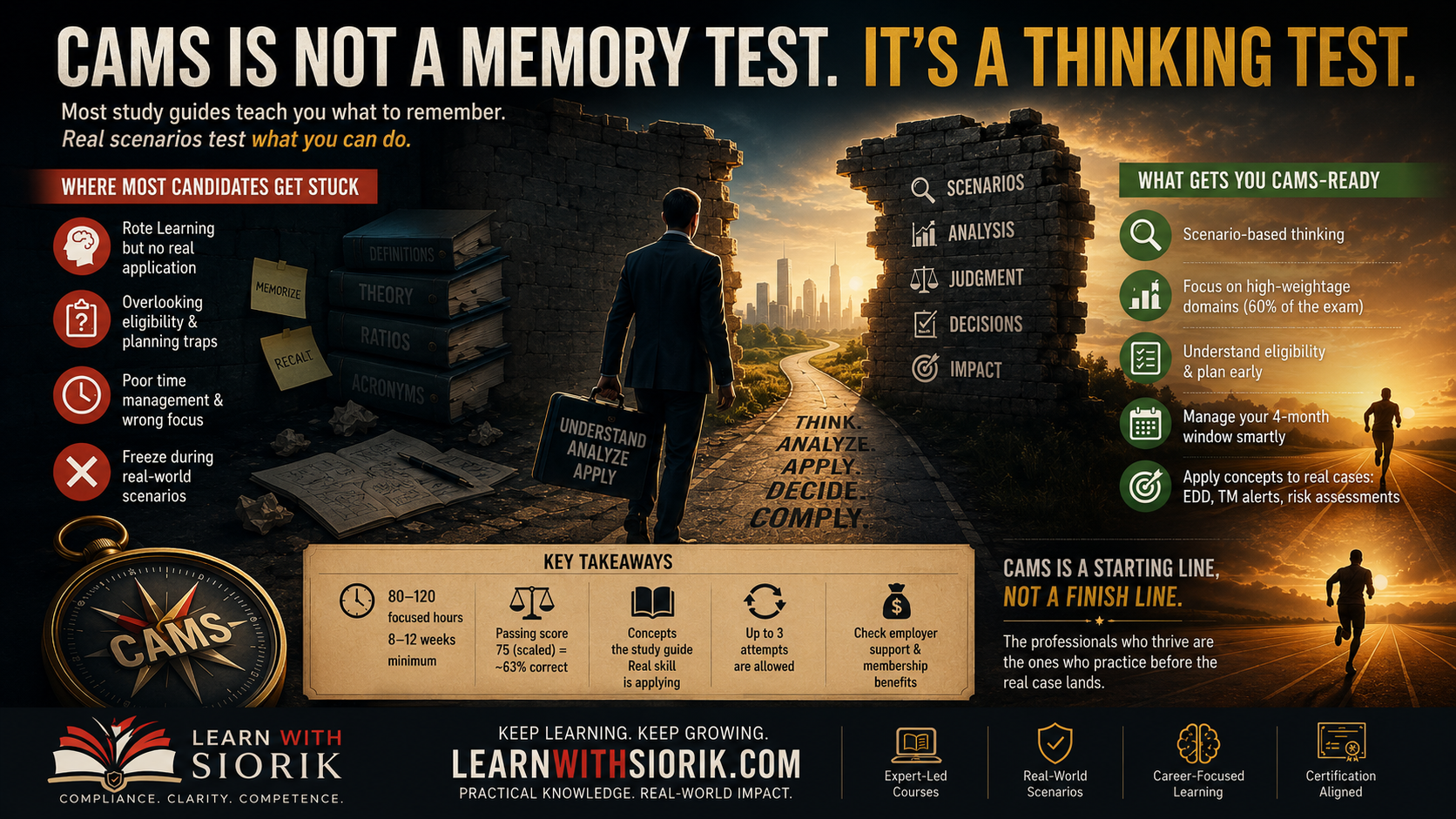
Most candidates need 80–120 hours of focused study, spread across 8–12 weeks. If you’re coming from a non-AML background, plan toward the higher end. Daily consistency—even 15 minutes of focused review—beats weekend marathon cramming every time.
Put your phone in another room during study sessions. Use the Pomodoro technique—25 minutes of deep focus, then a 5-minute break. This approach compounds quickly over 10 weeks and dramatically improves retention compared to distracted multi-hour sessions.
Conceptual Clarity Over Memorisation
Approximately 90% of CAMS questions are scenario-based. The exam won’t ask you to define “Enhanced Due Diligence.” It will present a scenario—a high-net-worth client from a jurisdiction with weak AML controls who structures deposits across multiple branches—and ask you what the compliance officer should do next. Understanding why a control exists matters far more than reciting its textbook definition.
Use ACAMS Resources—Plus Supplements
The official study guide, audio materials, and flashcards form your core. But the study guide alone is too concise for many scenario questions. Supplement with:
- FATF 40 Recommendations — the global standard-setter for AML/CFT.
- Wolfsberg Group Principles — practical correspondent banking and PEP guidance.
- Egmont Group case studies — real-world FIU cooperation examples that mirror exam scenarios.
“Picture two candidates sitting the CAMS exam on the same morning, both scoring well into the 90s. Six months later, one confidently drafts EDD questionnaires and defends alert decisions to her MLRO without blinking. The other stares at a blank template, quietly hoping nobody notices he’s guessing. Same certificate. Same score. The only difference: one had practised applying concepts before being asked to do it for real.”— Real-world observation from compliance hiring managers
5. Exam Day — Format, Scoring, and the Traps to Avoid
Format at a Glance
You’ll face 120 multiple-choice questions in 210 minutes (3.5 hours). That’s roughly 1 minute 45 seconds per question—generous if you’ve practised, punishing if you haven’t.
The Scoring Misconception
CAMS requires a scaled score of 75. This sounds like 75%, but it’s not a raw percentage. Because ACAMS adjusts scoring across exam versions to maintain fairness, the practical target is approximately 62.5% of questions answered correctly. Treat ~63%+ as your real benchmark—not the 75 the number initially implies.
Once your application is approved, you typically have around 4 months to schedule and sit the exam. This window is not open-ended. Treat it as a hard deadline the moment you’re approved—not a “someday” task. Candidates who delay scheduling often find themselves scrambling or missing the window entirely.
Retake Policy
If you don’t pass on your first attempt, you’re generally allowed up to three total attempts, with retake fees applying each time. Budget for this possibility rather than treating a first-attempt pass as the only acceptable outcome. Plenty of highly competent professionals need a second try—it says nothing about your long-term career trajectory.
Your 12-Week CAMS Preparation Timeline
Weeks 1–3: Foundation
Read the full study guide once (not highlighting). Download FATF Recommendations. Build your digital note structure with four domain folders.
Weeks 4–7: Deep Dive
Re-read the two 30%-weight domains in detail. Create mind maps linking concepts (e.g., PEPs → EDD → risk rating → SAR triggers). Begin flashcard drills and scenario-question practice.
Weeks 8–10: Application & Practice Exams
Shift to timed practice tests. Review every wrong answer and trace it back to the relevant study guide section. Supplement with Wolfsberg Principles and Egmont case studies.
Weeks 11–12: Final Review & Confidence Building
Skim mind maps daily. Focus only on weak areas identified in practice exams. Simulate exam conditions at least once with a full 3.5-hour timed sitting. Rest well the night before.
◆
Frequently Asked Questions
Conclusion — Passing Is the Starting Line, Not the Finish
The CAMS credential opens doors. It signals to employers, regulators, and peers that you understand the global AML/CFT landscape at a professional level. But passing the exam and being effective on the job are two very different things. The study guide teaches you concepts—”conduct a risk assessment,” “implement policies and procedures.” The job requires you to actually design an EDD form, tune a transaction monitoring system, and defend your SAR decisions to a senior MLRO.
Treat your CAMS preparation not just as exam prep, but as professional development. Practise applying concepts—alert review, EDD design, TM scenario analysis—so you walk into your next role already knowing what the work feels like. That’s the gap that separates a certificate holder from a capable compliance professional.
Conclusion
If you want to go beyond theory and build genuine, practical AML skill — not just enough to pass the exam, but enough to actually do the job with confidence on day one — the CAMS Study Guide alone was never going to get you there. It was never designed to. It tells you that risk assessment matters; it doesn’t show you how to actually build one for a high-risk client. It tells you transaction monitoring exists; it doesn’t show you what a real suspicious pattern looks like buried inside hundreds of ordinary transactions, or how to write a remark that actually holds up when your QC or MLRO reviews it.
That exact gap is why we built Job-Ready in AML/CFT: The Complete Compliance, Financial Crime & CAMS-Ready Course. It covers the same ground the CAMS exam tests — concepts, international standards, how a compliance program is actually structured, the full investigation process — but it doesn’t stop at theory. Woven through it are real, hands-on video walkthroughs from an actual AML system: how an alert moves through disposition from the moment it lands in the queue, how transaction monitoring rules trigger on real, messy account data, how to write a remark that survives review, and how a case escalates to QC and the MLRO. It’s built by Siorik Consultancy from 17+ years running AML/CFT compliance and QA programs across exchange houses and banking in the UAE and Nepal — the applied side of this work that no exam, however rigorous, was ever built to teach you.
At $29/month or $228/year with no auto-renewal, so you’re never quietly locked into paying for something you’ve already outgrown — you get access to all 8 courses on the platform, a completion certificate, CAMS-style practice quizzes, and an AI compliance chatbot to work through concepts as you study. Whether your goal is passing the CAMS exam, landing your first AML analyst role, or both at once, this is the practical half of the preparation you’ve already started just by reading this far.
[Explore the course at learnwithsiorik.com →]