

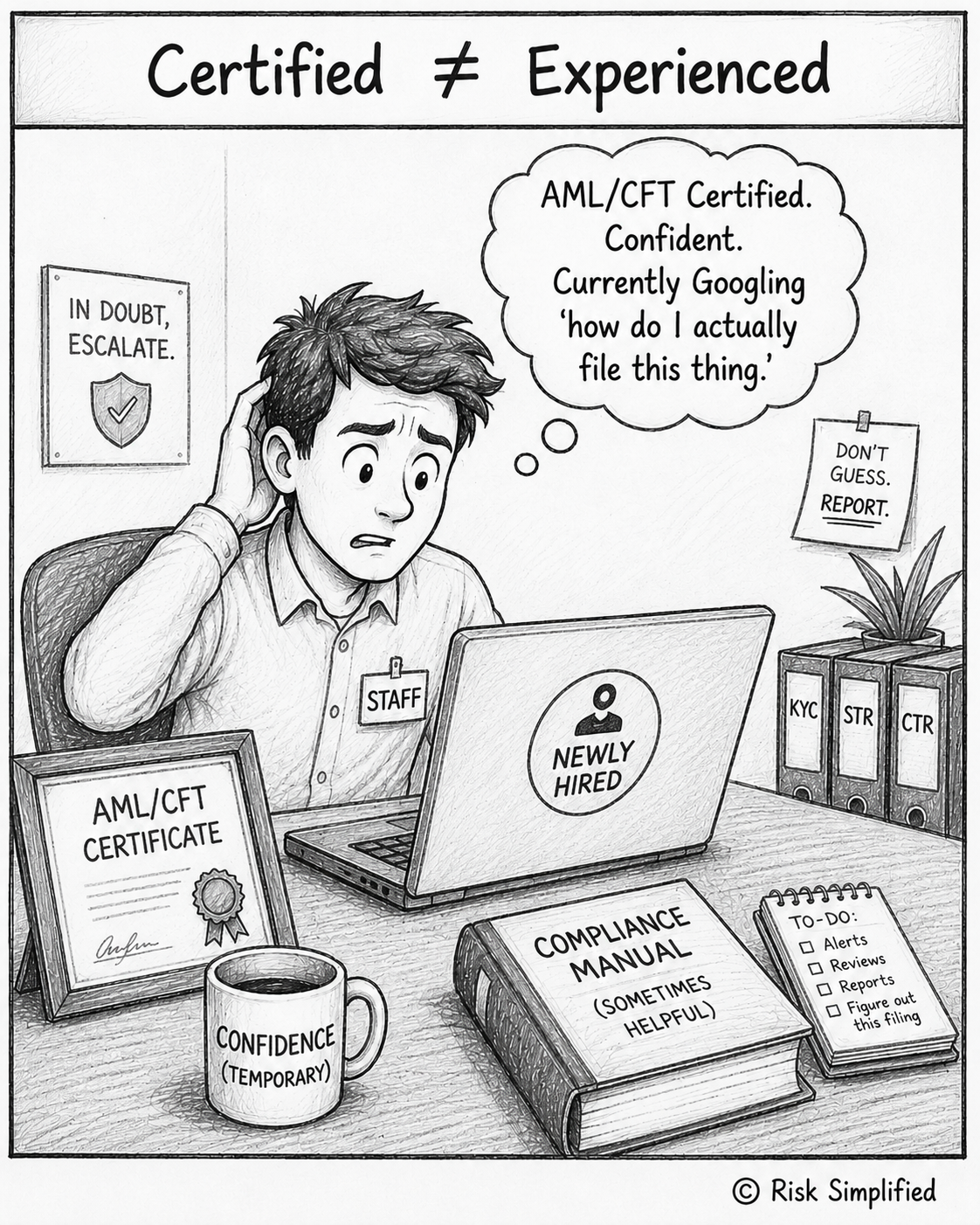
Your AML/CFT Certificate Proves You Studied. It Doesn’t Prove You Can Do the Job.
Why certification is necessary — but nowhere near sufficient — and what actually makes a compliance analyst job-ready.
A newly appointed analyst at a reputed financial institution held a well-regarded AML/CFT certification. He’d studied hard, passed the exam, and walked into his first compliance role with genuine confidence. Within weeks, he began noticing a pattern of structured transactions from a valued client relationship at his branch. Amounts just under the reporting threshold. Multiple transactions across consecutive days. He recognised the pattern immediately — textbook structuring. He could have written the exam question himself.
And yet, he processed every single one of those transactions without filing a suspicious transaction report.
The pressure — implicit from his line manager, woven into casual comments about the client’s importance to the branch — was enough. Not because he didn’t know better. Because knowing and doing are two very different things, and nothing in his certification had prepared him for the gap between them.
◆
Why a Certified Analyst Processed Suspicious Transactions — and Said Nothing
Let’s be precise about what happened here, because it’s tempting to dismiss this as a rogue employee or a character failure. It was neither. This analyst could define structuring correctly. He could list the red flags. He probably scored well on exactly that section of his exam.
What he could not do — because no one had ever taught him — was navigate the actual mechanics and human dynamics of the situation:
- How to process a transaction and still file a report. Many new analysts don’t realise that filing an STR does not necessarily mean blocking the transaction. They freeze, unsure of the procedural sequence, and default to doing nothing.
- How to push back on an implied instruction from a superior. The exam doesn’t simulate a line manager leaning on you. The real job does — regularly.
- How to document a defensible decision in the moment. Writing remarks that hold up under regulatory review is a practical skill. It requires training, not just theory.
This analyst’s failure wasn’t a knowledge gap — it was an applied-skill gap. He could identify the right answer among options on a screen. He could not execute the right action under real commercial, hierarchical, and time pressure. That distinction matters enormously, and it’s the distinction the industry keeps ignoring.
The Core Argument: Recognition vs. Judgment
Here is the thesis of this article, stated plainly: AML/CFT certification tests recognition. The job tests applied judgment under real pressure.
Certification teaches you to recognise that structuring is suspicious. The job requires you to file the report despite your manager’s displeasure, write remarks that a QC reviewer or MLRO can act on, and continue monitoring the client relationship for escalation — all while managing a queue of other alerts and meeting operational deadlines.
“Certification tells you what money laundering looks like. It doesn’t teach you what to do next — step by step, under pressure, with your manager watching.”— Siorik Consultancy, from 17+ years of AML/CFT QA reviews
We say this not to diminish certification. It is genuinely valuable for building foundational knowledge — international standards, the regulatory landscape, typologies, the components of a compliance programme. That foundation matters. But it is necessary, not sufficient, and treating it as proof of job readiness is where institutions — and analysts — get into trouble.
On-the-Job Training Isn’t Closing the Gap Either
If certification doesn’t teach applied skills, surely on-the-job training fills in the rest? That’s the assumption most institutions operate under. It is, in our experience, dangerously optimistic.
Here’s the problem: since certification doesn’t cover the practical piece, new analysts are expected to absorb it informally from more senior colleagues. But those senior colleagues were frequently never properly trained either. They learned from the person before them, who learned from the person before them — an unbroken chain of inherited shortcuts, pressure-driven compromises, and institutional habits dressed up as “how we do things here.”
Informal on-the-job mentoring only works when the mentor was properly trained. In many compliance teams, especially in exchange houses and mid-tier banks, that assumption doesn’t hold. The gap doesn’t close on its own over time — it compounds.
This is precisely the problem we at Siorik Consultancy have witnessed repeatedly. With over 17 years running AML/CFT compliance and quality-assurance programmes across exchange houses and banking institutions, we’ve reviewed thousands of alert dispositions, STR narratives, and escalation files. The same applied-skill gaps appear year after year — regardless of how many team members hold certification. That pattern is what made the need for a different kind of training impossible to ignore.
◆
The Real Stakes: What Happens When Applied Skills Are Missing
Let’s return to that analyst and name the consequences plainly:
Unreported suspicious activity is a regulatory failure — the institution is in breach. It is a reputational risk — one regulatory action or media report can undo years of trust-building. And it is a personal liability exposure for the analyst. The certificate on the wall doesn’t shield you when the regulator asks why you processed structured transactions and documented nothing. In fact, it makes it worse — it proves you knew what structuring was.
A certificate can actually increase your personal liability if things go wrong. It demonstrates to regulators that you possessed the theoretical knowledge to recognise the suspicious activity — making a failure to act harder to defend.
What’s Actually Missing — And How to Fix It
Let’s reframe the gap clearly. What was missing from that analyst’s preparation was not exam knowledge. And it was not generic “experience” either — since inherited experience from an undertrained mentor is not reliable. What was missing, specifically, was structured and correct hands-on training covering both the mechanics and the judgment of the job.
That means training that teaches you:
How to work through an alert from trigger to final disposition — including the exact steps for processing a transaction while still filing the required report.
How to write remarks and narratives that hold up under QC review, MLRO scrutiny, and regulatory examination — not vague notes, but precise, evidenced language.
Understanding how cases move from analyst to QC to MLRO — and what each level expects, so your escalation is actionable, not just a flag thrown over the wall.
Building the confidence and procedural clarity to do the right thing when a manager — or the culture of a branch — pushes you not to.
This is exactly the practical, hands-on approach behind the courses we built on LearnWithSiorik.com. Not because theory doesn’t matter — it does — but because theory without application produces certified professionals who freeze at the moment it counts most.
◆
Two Courses Built to Close the Gap
From 17+ years of reviewing what goes wrong — and why — we designed two courses that address the applied-skill gap directly:
Job-Ready in AML/CFT
This is the complete compliance analyst training programme: full theoretical foundation (concepts, international standards, compliance programme structure, investigations) plus embedded practical training modules. If you’re starting from zero and asking “how to become an AML analyst,” this is the course. It also builds a strong foundation for anyone planning to pursue AML/CFT certification afterward — you’ll sit that exam with real understanding, not just memorised answers. Click here to go to the course.
AML in Action
Pure hands-on, no theory modules. This is transaction monitoring training distilled: real alert disposition walkthroughs, how to write remarks that survive review, how cases escalate from analyst to QC to MLRO, rule types, spotting suspicious patterns, and distinguishing a true positive from noise. If you already hold an AML/CFT certification and just need the practical piece, this is exactly — and only — what you need. Click here to go to the course.
Use both courses together if you’re building AML analyst competency from the ground up. Use AML in Action alone if you’re already certified and need to close the applied-skills gap. Either way, the goal is the same: a compliance analyst who doesn’t just know the rules, but can execute under real-world conditions.
The Evolution of AML/CFT Training — and Where We Are Now
Early 2000s — Certification Era Begins
Industry certifications emerge as the gold standard for demonstrating AML/CFT knowledge. Institutions begin requiring them for compliance hires.
2010s — The Gap Becomes Visible
Regulators increase enforcement. QA reviews consistently reveal that certified analysts still make critical errors in alert handling, documentation, and escalation. The “certified but unprepared” pattern surfaces repeatedly.
2020s — Applied Training Finally Arrives
Practical, scenario-based AML/CFT compliance courses begin to fill the gap between certification and job readiness. Courses like those on LearnWithSiorik.com are designed specifically around real operational workflows.
◆
Frequently Asked Questions
◆
Back to That Analyst — And What Could Have Been Different
Certification alone couldn’t stop that transaction. It gave that analyst the vocabulary to describe what he was seeing — he could have named the pattern as structuring without hesitation. What it never gave him was the applied skill to act on that recognition when it actually mattered: how to process a transaction and still file the report, how to hold his ground against a manager’s implied pressure without it feeling like a career risk, how to document a decision that would stand up months later if anyone asked why he made the call he did.
Picture the same day with the right training already in place. Same client. Same pattern. Same pressure from the same line manager. The only difference is an analyst who has actually rehearsed this exact moment before — not in theory, but on a real system, working a scenario built to feel like this one. He knows how to write the report in a way that protects both him and the institution. He knows how to have the conversation with his manager that acknowledges the business relationship without compromising the obligation. He files it — and the two things he thought were in conflict turn out never to have been in conflict at all. They only felt that way because no one had ever shown him how to hold both at once.
That’s the entire gap this article has been describing. Not a knowledge gap. A rehearsal gap.
The Bottom Line
An AML/CFT certification will teach you what a suspicious transaction looks like. It won’t put you in the room when a manager is standing over your shoulder implying you shouldn’t flag it. Only real practice does that — the kind that comes from working an actual alert queue, writing an actual remark, and making an actual escalation decision before the stakes are real and the consequences are permanent.
That’s the gap Job-Ready in AML/CFT and AML in Action were built to close — not by replacing certification, but by giving you the applied skill certification was never designed to teach in the first place.
Ready to close the gap?
Explore Job-Ready in AML/CFT for the full foundation, or go straight to AML in Action for pure hands-on training — both available now at LearnWithSiorik.com.