

Passing the CFE Exam in 2026: The Complete Updated Guide to the New Three-Section Format
If you’ve been eyeing the Certified Fraud Examiner (CFE) credential, 2026 is a pivotal year. The ACFE relaunched the exam in June 2026 with a fundamentally restructured format — collapsing four sections into three, overhauling pricing, and tightening scheduling rules. Older study guides are now dangerously outdated. This comprehensive guide walks you through everything you need to know to pass the CFE exam on your first attempt under the new rules: eligibility requirements, the updated exam structure, realistic study strategies, costs, and the traps that catch unprepared candidates.
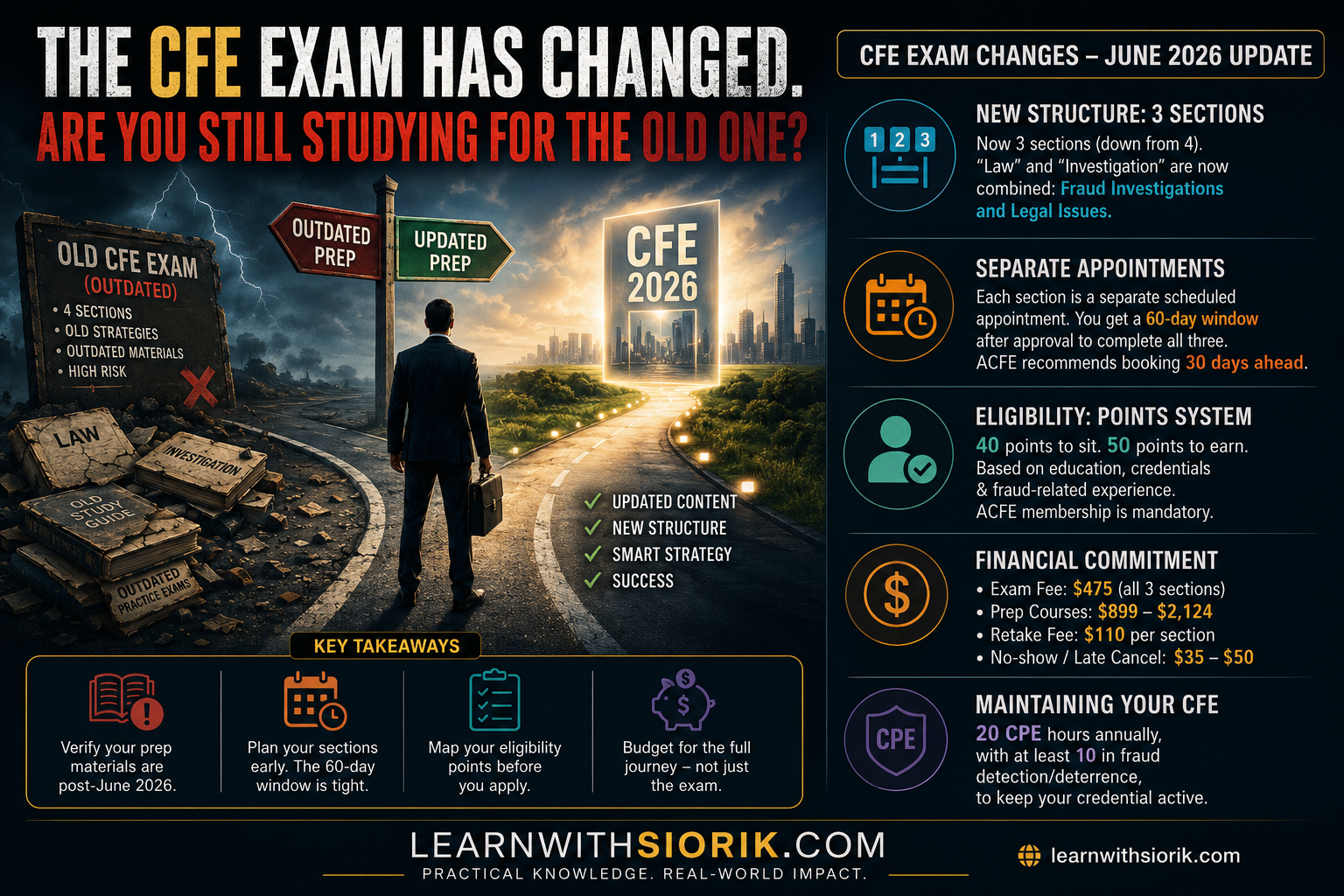
The CFE exam changed dramatically in June 2026. The old four-section structure (Financial Transactions & Fraud Schemes, Law, Investigation, Fraud Prevention & Deterrence) no longer exists. “Law” and “Investigation” were merged into a single section. If your study materials predate June 2026, you’re preparing for a ghost exam.
◆
The New CFE Exam Structure: What Changed and Why It Matters
The ACFE’s decision to consolidate the exam from four sections to three wasn’t cosmetic — it reflects how fraud examination actually works in practice. Investigations and legal issues are inseparable in real casework, so the merged section tests them together. Here’s what you’re sitting for now:
Each section is a separate scheduled appointment at a Prometric testing centre — not a single marathon sitting. You’ll receive a preliminary score report within 24 hours of completing each section. Unanswered questions are not scored as incorrect in the traditional sense; they’re locked and treated as unanswered, which functionally means zero credit. Never leave a question blank.
Unanswered questions earn zero credit and cannot be revisited once locked. With 120 questions in 150 minutes, you have roughly 75 seconds per question on the two larger sections. Time management isn’t optional — it’s a pass/fail variable.
Eligibility: The Points System Most Candidates Overlook
Before you can even register for the exam, you need to qualify through the ACFE’s point-based eligibility system. This catches many aspiring CFEs off guard because it operates on a two-tier threshold:
- 40 points — required to sit for the exam
- 50 points — required to complete the CFE credential after passing
- ACFE membership — mandatory; only active members can earn the CFE designation
Points are earned through a combination of formal education (degrees), professional credentials (CPA, CIA, JD, etc.), and fraud-related work experience. A bachelor’s degree alone won’t get you to 40 points — you’ll typically need at least two years of professional experience in a fraud-adjacent role. Plan your application timeline well before you plan your study schedule.
Gather all documentation for your eligibility application — transcripts, certifications, employer verification letters — before you start studying. Application processing takes time, and your 60-day exam window starts the moment you’re approved, not when you feel ready.
The 60-Day Window: A Scheduling Trap with Real Consequences
Here’s where candidates who don’t read the fine print get burned. Once your application is approved and eligibility activated, you have exactly 60 days to schedule and complete all three exam sections. That clock starts immediately — not when you book your first appointment.
Since each section is a separate Prometric appointment, seat availability matters. The ACFE recommends scheduling roughly 30 days in advance to secure preferred dates and locations. If you wait until week five of your window to start booking, you may find that the only available slots are at testing centres hours away — or worse, beyond your 60-day deadline.
Have all eligibility documents ready before you apply. Factor in processing time so your 60-day window aligns with your study timeline.
The moment you receive your eligibility confirmation, book all three Prometric appointments. Space them 7–14 days apart to allow focused review between sections.
Do 80% of your studying before your eligibility is activated. Use the 60-day window for review, practice exams, and the exams themselves — not first-pass learning.
Prometric charges $35 for changes made 3–29 days before your exam. The ACFE charges $50 for cancellations within 3 days or no-shows. Budget for contingencies.
◆
Costs: What You’ll Actually Spend
The ACFE simplified exam pricing to a flat $475 fee covering your first attempt on all three sections. That’s the good news. The less-good news: everything around it adds up fast.
Retaking any single failed section costs $110. And if you want the ACFE’s official prep materials — which most successful candidates rely on — you’re looking at significantly more:
- Silver Prep Course Package: $899–$1,124 (member/non-member)
- Platinum Prep Course Package: $1,699–$2,124 (member/non-member)
The Fraud Examiners Manual, once sold separately, is now bundled into these packages. ACFE membership itself carries an annual fee. Realistically, a first-time candidate should budget $1,500–$2,800 all-in, depending on package choice and membership status.
“The CFE isn’t just a test of knowledge — it’s a test of planning. The candidates who fail aren’t usually the ones who didn’t study hard enough; they’re the ones who didn’t manage the logistics.”— Senior ACFE Chapter Leader, 2026
Study Strategy: How to Prepare for Each Section
Section 1: Fraud Schemes & Financial Crimes (120 Qs / 2.5 hrs)
This is the heaviest content section. Expect deep coverage of asset misappropriation, corruption, financial statement fraud, money laundering typologies, and cybercrime schemes. Focus on understanding how schemes work mechanically — the exam tests application, not just recall. Work through case studies and real-world fraud scenarios.
Section 2: Fraud Investigations & Legal Issues (120 Qs / 2.5 hrs)
The merged section demands fluency in both investigative techniques (interviewing, evidence handling, digital forensics, report writing) and the legal framework governing fraud cases (civil vs. criminal proceedings, evidence admissibility, whistleblower protections, corporate liability). Pay special attention to where investigation practice intersects with legal constraints — that’s the testing sweet spot created by the merger.
Section 3: Fraud Prevention & Deterrence (70 Qs / 1.5 hrs)
Smaller but not easier. This section covers internal controls, corporate governance, ethics programs, risk assessment frameworks, and the human behavioural drivers of fraud. Don’t underestimate it — candidates who treat it as an afterthought often miss the 75% threshold here while passing the larger sections.
Allocate your study time proportionally: roughly 35% to Fraud Schemes, 40% to Investigations & Legal Issues (it’s the broadest combined topic), and 25% to Prevention & Deterrence. Take at least two full-length timed practice exams per section before sitting for the real thing.
The Evolution of the CFE Exam: A Brief Timeline
1988 — ACFE Founded
The Association of Certified Fraud Examiners is established, creating the CFE credential as the gold standard for anti-fraud professionals.
2002–2015 — Four-Section Era
The exam stabilises around four sections: Financial Transactions, Law, Investigation, and Prevention & Deterrence. Materials and prep courses expand significantly.
2020–2025 — Digital Transformation
Prometric computer-based testing becomes standard. Content modernises to include cybercrime, cryptocurrency fraud, and data analytics.
June 2026 — The Relaunch
Four sections become three. “Law” and “Investigation” merge into “Fraud Investigations & Legal Issues.” Pricing, scheduling, and eligibility requirements are overhauled. Membership exceeds 95,000 worldwide.
◆
After You Pass: The Recertification Requirement
Passing the exam isn’t the finish line — it’s the starting gate. CFEs must complete 20 hours of Continuing Professional Education (CPE) annually, with at least 10 hours specifically in fraud detection or deterrence. Failing to meet this requirement puts your credential in inactive status. The ACFE audits CPE compliance, so don’t treat this as optional.
Many newly certified CFEs lose their credential within the first two years by neglecting CPE requirements. Set calendar reminders and track your hours proactively — don’t let a hard-earned credential lapse due to administrative oversight.
Frequently Asked Questions
◆
Conclusion: Plan the Logistics as Carefully as You Study the Content
The 2026 CFE exam rewards candidates who treat preparation as a project, not just a study sprint. Verify your eligibility points early. Budget realistically for exam fees and updated prep materials. Schedule your Prometric appointments the day your window opens. Study with post-June-2026 materials only. And once you pass, build CPE tracking into your professional routine from day one.
The CFE credential remains one of the most respected designations in financial crime and fraud examination — now held by professionals in over 95,000-strong global community. The exam is harder to navigate logistically than it was a year ago, but the payoff in career credibility and opportunity hasn’t changed. If you’re ready, start your eligibility application today. The clock starts ticking the moment you’re approved.
- Tags:
- Certified Fraud Examiner
- CFE