

Mixers, Tumblers, and Tornado Cash: The Compliance Officer’s Guide to Obfuscation Typologies
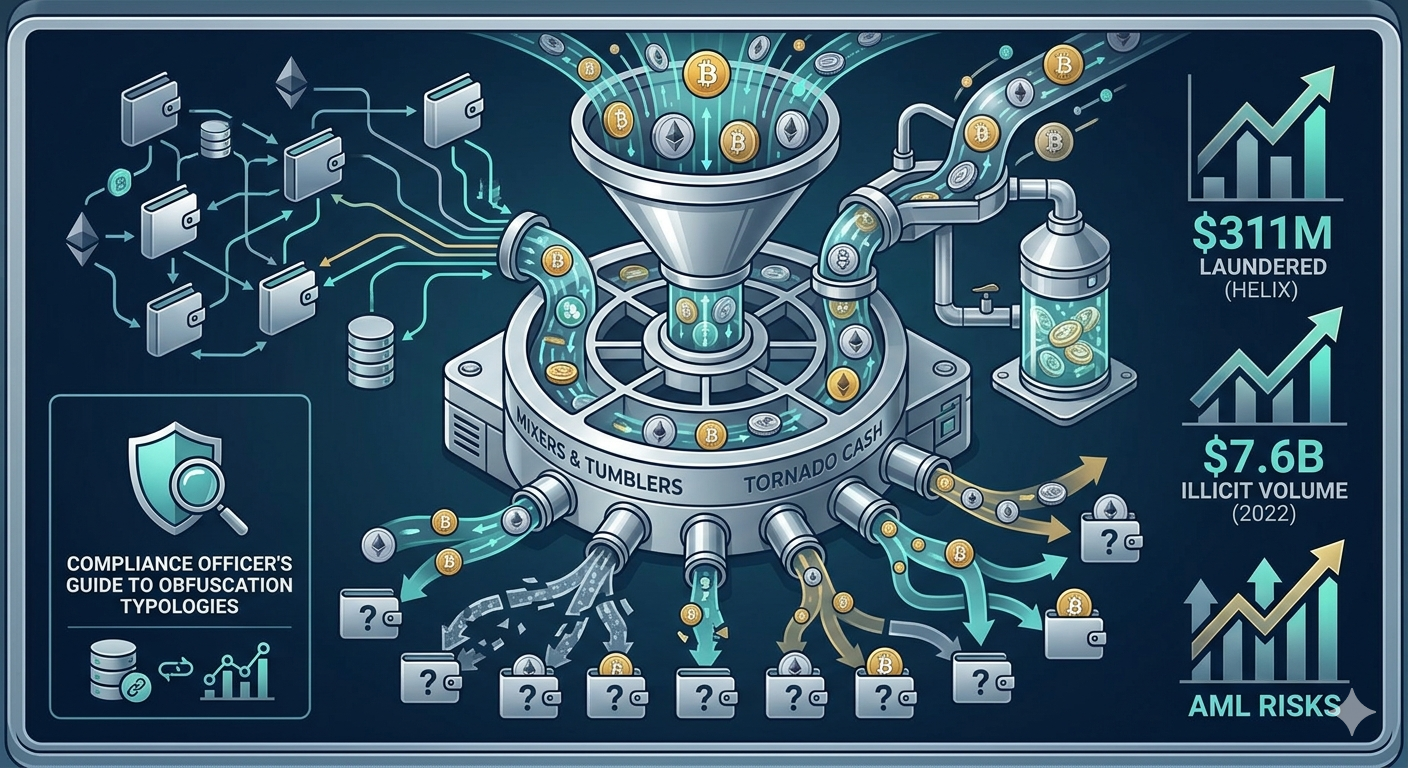
In the ever-evolving landscape of cryptocurrency-facilitated financial crime, few tools have posed as significant a challenge to compliance professionals as mixing and tumbling services. From centralized Bitcoin mixers like Helix — which laundered over $311 million before attracting FinCEN’s first-ever penalty against a mixer operator — to decentralized smart-contract protocols like Tornado Cash, obfuscation technologies represent a direct and deliberate assault on the traceability that underpins effective anti-money laundering (AML) frameworks. For compliance officers at virtual asset service providers (VASPs), banks with crypto exposure, and fintech firms operating in this space, understanding how these tools work, how regulators classify them, and how to detect tainted funds despite obfuscation is no longer optional — it is an existential competency. This guide provides a comprehensive, jurisdiction-aware analysis designed to equip senior compliance professionals with the knowledge and practical frameworks they need to address mixer-related risks head-on.
◆
How Mixers and Tumblers Actually Work
At their core, mixers and tumblers are designed to sever the on-chain link between the sender and receiver of cryptocurrency. While the terminology is often used interchangeably, subtle distinctions exist that compliance professionals should understand in order to accurately classify risk and file intelligence reports.
Centralized mixers (also called “tumblers”) operate as custodial intermediaries. A user sends funds to the mixer, which pools them with other users’ deposits, then redistributes equivalent amounts — minus a service fee — to fresh output addresses after randomized time delays. The operator holds temporary custody and maintains a transaction log (which may or may not be deleted). Helix, Bestmixer.eu, and Bitcoin Fog are well-known examples of centralized mixers that have faced law enforcement action.
Decentralized mixing protocols, exemplified by Tornado Cash on Ethereum, use smart contracts and zero-knowledge proofs (specifically zk-SNARKs) to break the transactional link without a custodial intermediary. Users deposit a fixed denomination of ETH or ERC-20 tokens into a smart-contract pool, receive a cryptographic “note” (a secret), and later use that note to withdraw funds to an entirely new address. The smart contract verifies the withdrawal is valid without revealing which deposit it corresponds to. Because no single entity holds custody, these protocols present unique challenges for sanctions enforcement and takedown operations.
The critical distinction for compliance purposes is not whether a mixer is centralized or decentralized, but whether your institution can detect exposure to mixer-associated addresses. Blockchain analytics platforms like Chainalysis, Elliptic, and TRM Labs maintain continuously updated clustering databases that can identify mixer pool addresses, intermediate hops, and even probabilistic links to post-mix outputs — making “perfect” obfuscation increasingly difficult.
CoinJoin protocols, such as Wasabi Wallet and JoinMarket, represent a third category. These are collaborative transaction structures where multiple users combine their inputs and outputs into a single large transaction, making it statistically difficult to determine which input funded which output. While CoinJoins are often framed as privacy tools rather than laundering infrastructure, regulators make no such distinction when the underlying funds are illicit.
◆
The Regulatory Landscape: UAE, UK, and International Standards
The regulatory response to mixers has evolved rapidly since 2020, driven by high-profile enforcement actions and FATF guidance. Compliance officers operating across jurisdictions must understand the distinct — and sometimes divergent — approaches taken by key regulatory regimes.
“Countries should ensure that VASPs are able to identify and assess the ML/TF risks that may arise in relation to the use of mixing, tumbling, or similar services, and take appropriate measures to mitigate those risks.”— FATF Updated Guidance for a Risk-Based Approach to VAs and VASPs, 2021, para. 167
In the UAE, the regulatory framework is notably prescriptive. VARA’s Technology and Security Rules (2023) explicitly require VASPs to block or flag transactions originating from known mixer addresses using blockchain analytics intelligence. The AMLSCU’s goAML typologies library designates mixer-related transactions as Typology T-19, mandating STR filing with supporting blockchain analytics evidence. Furthermore, under Cabinet Decision 74/2020, mixer-linked transactions may constitute proliferation financing support, triggering immediate reporting obligations.
In the UK, the approach is structurally different. Rather than creating mixer-specific typology classifications, the UK leverages existing legislation — principally POCA 2002 s.327, which criminalizes the concealment of criminal property — and mirrors US OFAC sanctions through OFSI designations. The NCA’s 2023 National Strategic Assessment designated mixers as a “primary crypto ML vector,” and the FCA requires firms to screen against mixer and tumbler wallet addresses using risk-based blockchain analytics.
Under both UAE and UK frameworks, failure to screen for mixer exposure is not merely a compliance gap — it constitutes potential criminal facilitation. In the UAE, VARA-licensed entities that fail to block known mixer addresses risk license revocation and criminal referral. In the UK, processing funds with known mixer provenance without filing a SAR and obtaining NCA consent (via the DAML regime) can result in principal money laundering charges carrying up to 14 years imprisonment.
◆
Enforcement Timeline: From Helix to Tornado Cash and Beyond
The regulatory and enforcement trajectory against mixers has accelerated dramatically over the past five years. Understanding this timeline is essential for compliance professionals seeking to anticipate where the regulatory frontier is heading next.
2020 — FinCEN’s First Mixer Penalty
Larry Dean Harmon, operator of Helix mixer, received a $60 million civil penalty from FinCEN for operating an unregistered money services business that processed over $311 million in Bitcoin. This landmark action established that mixer operators are money transmitters under the BSA.
August 2022 — OFAC Sanctions Tornado Cash
US Treasury’s OFAC designated Tornado Cash under Executive Order 13694, marking the first-ever sanctioning of a decentralized smart-contract protocol. Over $7 billion had been processed through the protocol, including $455 million stolen by the North Korea-linked Lazarus Group. UK OFSI subsequently issued corresponding designations.
2023 — Arrests and Criminal Charges
Tornado Cash developer Alexey Pertsev was arrested in the Netherlands and convicted of money laundering in May 2024. Roman Storm, another co-founder, was indicted in the US on money laundering and sanctions evasion charges. These cases established developer liability for creating and maintaining obfuscation tools.
2024 — UAE and Global Regulatory Tightening
CBUAE and VARA issued a joint circular classifying mixers as high-risk counterparties. The Wolfsberg Group updated its VASP questionnaire to require disclosure of mixer-exposure controls, with non-disclosure constituting grounds for relationship termination.
Building a Mixer Detection and Response Framework
Knowing the risks and regulations is necessary but insufficient. Compliance officers must translate this knowledge into operationally effective controls. The following framework outlines the essential steps for building a robust mixer detection and response capability.
Deploy enterprise-grade blockchain analytics tools (Chainalysis KYT, Elliptic Lens, TRM Labs) to screen all deposit and withdrawal addresses against continuously updated mixer cluster databases. Ensure both direct exposure (funds received directly from a mixer) and indirect exposure (funds within N hops of a mixer) are scored and flagged.
Establish clear, board-approved policies on acceptable mixer exposure. Many leading VASPs set a zero-tolerance threshold for direct mixer exposure and a materiality threshold (e.g., >10% of transaction value) for indirect exposure. Document these thresholds in your risk appetite statement and ensure they are calibrated to jurisdictional requirements.
Configure transaction monitoring systems to automatically reject or hold transactions that exceed your mixer exposure thresholds. Build escalation workflows that route flagged transactions to trained investigators with blockchain forensics expertise, ensuring the investigation file captures wallet addresses, transaction hashes, and analytics screenshots.
When filing suspicious transaction reports, include blockchain analytics evidence: the mixer service identified, wallet address clusters, transaction flow diagrams, and exposure percentages. In the UAE, reference AMLSCU Typology T-19 in your goAML filing. In the UK, request a Defence Against Money Laundering (DAML) consent from the NCA before proceeding with any transaction.
Conduct regular training for front-line staff, investigators, and senior management on emerging mixer typologies. Update your internal typology library quarterly to reflect new mixer protocols, chain-hopping techniques, and cross-chain bridge exploits that criminals use to layer funds post-mixing.
When assessing counterparty VASPs, use the Wolfsberg Group VASP questionnaire to evaluate their mixer-exposure controls. If a counterparty VASP cannot demonstrate blockchain analytics integration, defined mixer exposure thresholds, and a documented mixer incident response procedure, this should be treated as a material due diligence deficiency and grounds for enhanced monitoring or relationship termination.
◆
Frequently Asked Questions
◆
Mixers, tumblers, and decentralized obfuscation protocols are not going away — they are evolving. Cross-chain bridges, privacy coins, and novel zero-knowledge constructions will continue to challenge compliance frameworks in the years ahead. The compliance officers who will succeed are those who invest now in blockchain analytics capabilities, build jurisdiction-specific response playbooks, and maintain continuous dialogue with regulators and intelligence units. Review your institution’s mixer exposure controls today. Audit your blockchain analytics coverage, validate your exposure thresholds against current regulatory expectations, and ensure your investigation teams can produce the forensic evidence that regulators — and courts — increasingly demand. The cost of preparedness is a fraction of the cost of enforcement action.