

Agentic AI for Autonomous SAR/STR Drafting and Filing: Transforming Financial Crime Reporting from Hours to Minutes
Suspicious Activity Reports (SARs) and Suspicious Transaction Reports (STRs) remain the single most critical output of any Anti-Money Laundering (AML) compliance programme. They are the primary mechanism through which the private sector communicates intelligence to Financial Intelligence Units (FIUs) — yet the process of drafting, reviewing, and filing these reports has remained stubbornly manual, resource-intensive, and plagued by inconsistent quality for decades. FATF Recommendation 20 mandates prompt reporting of suspicion, but the reality on the ground tells a different story: analysts spend hours collating evidence from disparate systems, struggling to weave coherent narratives, and navigating complex filing platforms such as the UAE’s goAML or the UK NCA’s UKFIU portal. Enter Agentic AI — a paradigm shift beyond traditional automation that empowers autonomous AI agents to gather evidence, structure narratives, cross-reference typologies, and even submit filings, reducing what once took hours to mere minutes while dramatically improving the quality regulators demand.
◆
The SAR/STR Quality Crisis: Why the Status Quo Is Failing
Despite billions of dollars spent annually on compliance operations worldwide, the quality of SARs and STRs remains a persistent concern for regulators. Reports are frequently criticised for incomplete narratives, missing contextual information, inconsistent formatting, and delayed filing. The root cause is structural: analysts are expected to manually interrogate transaction monitoring systems, core banking platforms, KYC repositories, adverse media databases, and sanctions screening tools — then synthesise all of this into a compelling, regulation-compliant narrative under tight deadlines.
The problem compounds in jurisdictions like the UAE, where the Central Bank (CBUAE) mandates filing through the goAML platform with structured XML fields, predefined typology codes, and mandatory supporting documentation. In the UK, the NCA’s UKFIU similarly expects detailed narratives that articulate the basis of suspicion, the parties involved, and the financial flows with precision. When analysts are rushed or undertrained, the intelligence value of these filings deteriorates — ultimately undermining the very purpose of the AML/CFT regime.
Poor-quality SARs don’t just invite regulatory censure — they actively impair law enforcement’s ability to detect and disrupt money laundering, terrorist financing, and proliferation financing networks. A defensive, low-value filing is not compliance; it is a systemic vulnerability.
◆
Understanding Agentic AI: Beyond Chatbots and Copilots
Agentic AI represents a fundamentally different architecture from the generative AI tools most compliance teams have begun experimenting with. While a chatbot or copilot responds to prompts and requires continuous human direction, an agentic system operates with goal-directed autonomy. Given an objective — “draft an STR for case #47291 and prepare it for goAML submission” — the agent independently plans its workflow, determines which data sources to query, executes those queries, evaluates the results, and iterates until the objective is met.
“The distinguishing feature of agentic AI is not intelligence alone — it is agency. The system reasons about sub-tasks, uses tools, recovers from errors, and delivers a completed artefact, not merely a suggestion.”— FATF, Opportunities and Challenges of New Technologies for AML/CFT (Updated 2024)
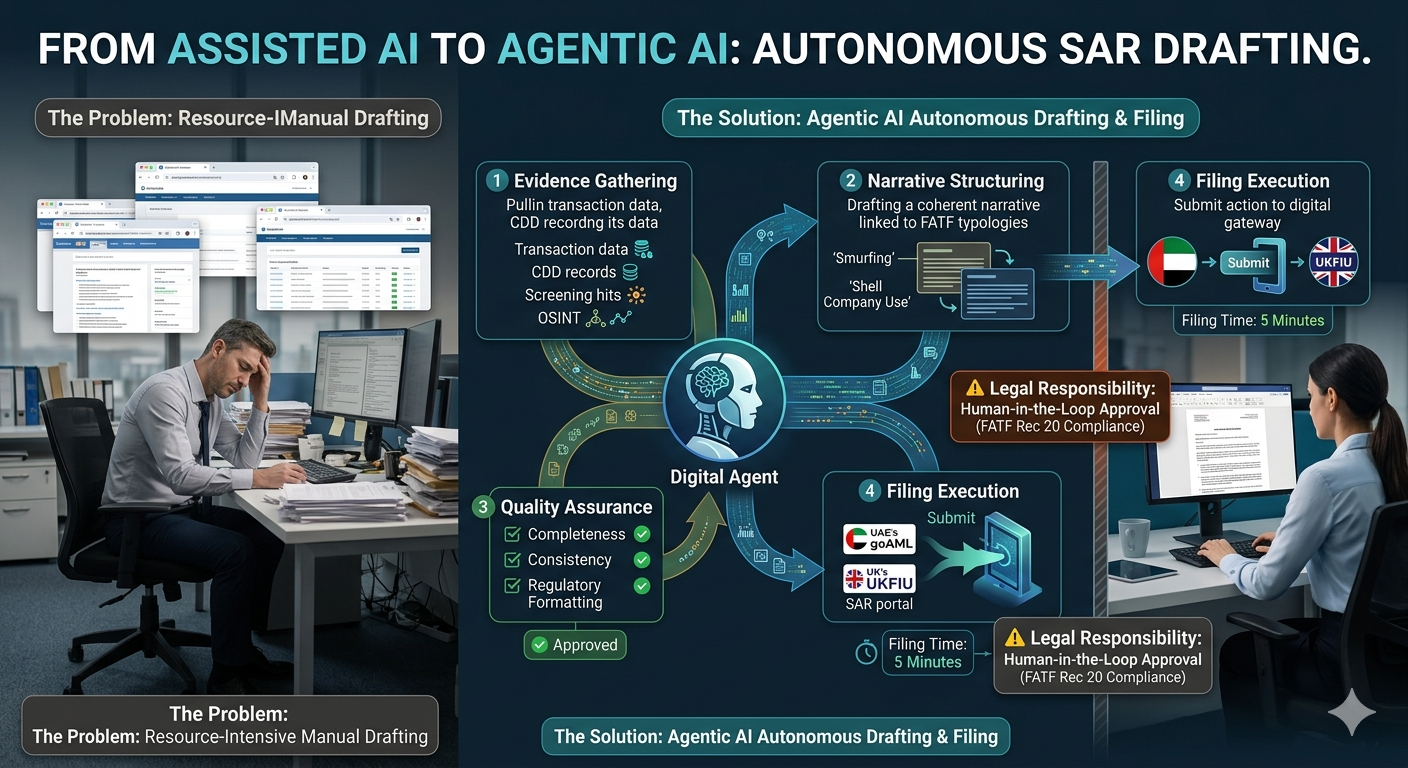
In the SAR/STR context, this means the agent can autonomously access the case management system, pull transaction data, retrieve CDD/EDD files, check sanctions and PEP lists, run adverse media searches, identify matching FATF typologies, construct a chronological narrative, populate the required regulatory fields, and present the completed draft for human review — all without the analyst needing to copy-paste between twelve different screens.
◆
How Agentic AI Drafts and Files a SAR/STR: A Step-by-Step Workflow
To make this concrete, let us walk through how an agentic AI system would handle a typical STR filing destined for the UAE’s goAML platform, from case escalation to submission-ready draft.
The agent receives a case ID from the transaction monitoring or case management system. It parses the alert details, identifies the subject(s), and establishes its goal: produce a complete goAML-compliant STR package.
The agent queries core banking systems for transaction history, retrieves KYC/CDD documents, runs real-time sanctions and PEP screening, pulls adverse media results, and checks internal SARs history for prior filings on the same subject or network.
Using a vector-embedded library of FATF typologies, CBUAE guidance, and historical FIU feedback, the agent identifies which money laundering or terrorist financing typology the activity most closely matches — such as trade-based laundering, smurfing, or shell company layering — and articulates the indicators present.
The agent constructs a structured narrative covering the who, what, when, where, why, and how — chronologically ordered, with embedded transaction references. It simultaneously populates goAML XML fields: report type, subject details, involved accounts, transaction summaries, and suspicion indicators.
The completed draft is presented to a senior analyst or MLRO for review. The agent highlights areas of uncertainty, flags data gaps, and provides a confidence score. Upon approval, it can submit the report via API integration with goAML or the UKFIU portal.
The “human-in-the-loop” step is not optional — it is a regulatory and ethical imperative. Agentic AI does not replace the MLRO’s judgement; it eliminates the hours of mechanical data gathering and formatting so that human expertise is focused where it matters most: exercising professional suspicion and making the filing decision.
Regulatory Landscape: FATF R.20, goAML, and the UKFIU
The regulatory foundations for SAR/STR filing are well-established, but they are evolving to accommodate — and increasingly expect — technological sophistication. Understanding the regulatory nuances across jurisdictions is essential for any institution deploying agentic AI in this space.
FATF Recommendation 20 (Global Standard)
Requires financial institutions to report promptly to the FIU when they suspect or have reasonable grounds to suspect that funds are proceeds of a criminal activity or related to terrorist financing. FATF’s 2021–2024 technology guidance explicitly encourages the responsible use of AI and advanced analytics to enhance reporting quality and timeliness.
UAE CBUAE goAML Platform (2020–Present)
The UAE mandates all STR/SAR filings through the UNODC-developed goAML system. Reports must include structured XML data, predefined suspicion indicator codes, and detailed narrative sections. The platform’s API capabilities make it technically feasible for agentic AI systems to prepare and submit filings programmatically, subject to institutional approval workflows.
UK NCA UKFIU SAR Online Portal (Ongoing Evolution)
The UK’s regime under POCA 2002 and the Terrorism Act 2000 requires SAR filing to the UKFIU. The NCA has published guidance emphasising narrative quality and the “reason for suspicion” articulation. The SAR Reform Programme signals a push toward structured data submissions — an environment where agentic AI can deliver enormous value.
Before deploying agentic AI for SAR/STR drafting, conduct a thorough regulatory mapping exercise for each jurisdiction in which you operate. Ensure the AI agent’s output templates are validated against current goAML XML schemas, UKFIU formatting requirements, and any local FIU-specific guidance. Build regulatory change monitoring into the agent’s update cycle.
Governance, Risks, and Guardrails for Responsible Deployment
The promise of agentic AI is immense, but so are the risks if deployment is ungoverned. Compliance leaders must establish robust guardrails that balance autonomy with accountability. The agent’s decisions — which data to include, which typology to cite, how to frame the narrative — all carry regulatory consequences. Model hallucination, data leakage, bias amplification, and over-reliance on automation are real threats that demand mitigation.
An agentic AI system that fabricates transaction details or invents suspicious indicators — a phenomenon known as “hallucination” — could result in filing a materially false SAR. This exposes the institution to regulatory sanctions, reputational damage, and potential criminal liability for the MLRO. Rigorous validation layers and audit trails are non-negotiable.
Key governance considerations include: maintaining comprehensive audit trails of every agent action and data source accessed; implementing confidence scoring so that low-certainty drafts are routed for enhanced human review; establishing model validation and back-testing protocols using previously filed and FIU-accepted SARs; ensuring data access controls so the agent operates under the principle of least privilege; and creating kill-switch mechanisms that allow immediate deactivation if the agent produces anomalous outputs.
◆
Frequently Asked Questions
◆
Agentic AI for SAR/STR drafting is not a distant aspiration — it is an emerging operational reality. The institutions that move decisively to pilot these systems today, with proper governance frameworks and human-in-the-loop controls, will not only reduce compliance costs but will fundamentally elevate the quality of financial intelligence reaching FIUs worldwide. For compliance leaders, the call to action is clear: begin your proof-of-concept now. Map your SAR workflow end-to-end, identify the highest-friction steps, engage your technology partners on agentic AI capabilities, and establish the governance guardrails that will allow you to deploy responsibly. The gap between organisations that embrace this transformation and those that cling to manual processes will widen rapidly — and regulators, increasingly, will expect you to be on the right side of it.